You step off the plane in Lisbon, Tokyo, or Mexico City, and instead of hailing a taxi, you walk straight to the nearest metro station—confident, calm, and ready to blend in. No frantic map-squinting. No overpaying for rideshares. Just you and the rhythm of the city, moving together like you belong.
This isn’t just a fantasy. With the right mindset and a few universal strategies, any traveler can use public transit like a local—even on their first visit. And doing so unlocks a richer, more authentic travel experience: you’ll save money, reduce stress, discover hidden neighborhoods, and connect with the everyday life of your destination in a way car travel never allows.
The best part? You don’t need to speak the language, memorize complex maps, or own a fancy transit pass. Modern tools, observation, and a little cultural awareness are all it takes.
In this guide, you’ll learn a repeatable system for mastering public transit in any city worldwide. We’ll cover how to prepare before you go, decode signage and maps on the fly, choose the right payment method, follow unspoken etiquette rules, and handle common challenges with ease. Whether you’re navigating the Tokyo subway or hopping on a Bogotá bus, these tips will help you ride with confidence—and maybe even strike up a conversation with a friendly local along the way.
Why Public Transit Is Your Secret Travel Superpower
Using public transportation isn’t just practical—it’s transformative.
First, the numbers: a single subway ride in most major cities costs $1–$3, while a short Uber can easily hit $15–$30. Over a week, that difference funds a gourmet dinner or a museum tour.
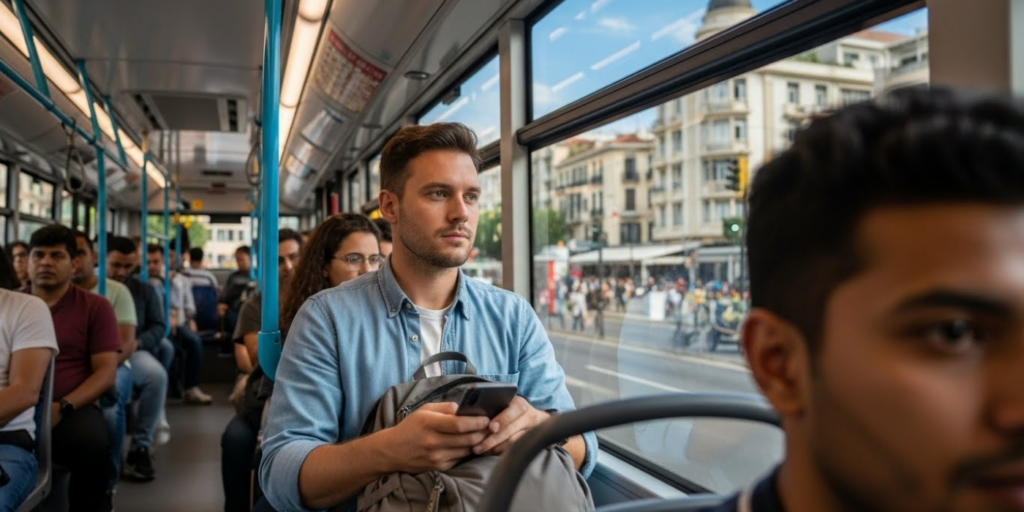
But beyond savings, transit offers immersion. On a local bus, you’ll see how people dress, what they read, how they interact. You’ll pass through residential streets, markets, and parks that never appear in guidebooks. You’ll experience the city’s pulse—not just its postcard highlights.
According to a 2024 study by the International Transport Forum, travelers who use public transit spend 40% more time exploring neighborhoods and report higher satisfaction with their trips than those relying on cars or tours.
And let’s not forget sustainability: one full bus replaces 30–40 cars, reducing congestion and emissions. Choosing transit is a small act of respect—for the city and its residents.
The key? Stop seeing transit as a challenge. Start seeing it as your gateway.
Before You Go: Smart Prep in Under 15 Minutes
You don’t need to become an expert—just do these three things:
1. Download the Right Apps
- Google Maps: Reliable in 200+ countries. Shows real-time departures, walking directions to stations, and step-by-step transit routes.
- Citymapper: Best in global hubs like London, NYC, Paris, Berlin, and Tokyo. Includes platform numbers, service alerts, and “get me home” features.
- Moovit: Excellent for bus-heavy cities and real-time tracking.
Enable offline maps for your destination in Google Maps—just in case Wi-Fi is spotty.
2. Understand Payment Options
Most cities have moved beyond paper tickets:
- Contactless credit/debit cards: Tap to pay (London, Chicago, Sydney, Vancouver).
- Reloadable transit cards: Like Oyster (London), Suica (Tokyo), or TAP (Los Angeles). Buy at the airport or major stations.
- Mobile wallets: Some cities (like Seoul or Singapore) let you pay via Apple Pay or local apps.
Avoid single-ride tickets—they’re often more expensive and slower to use.
3. Learn Key Phrases (Even Just One!)
Save these in your phone notes:
- “Where is the metro/bus stop?”
- “Does this train go to [landmark]?”
- “How much is a ticket?”
Even if you don’t speak the language, trying shows respect—and locals often go out of their way to help.
At the Station: Reading Signs Like a Pro (Even in a Foreign Language)
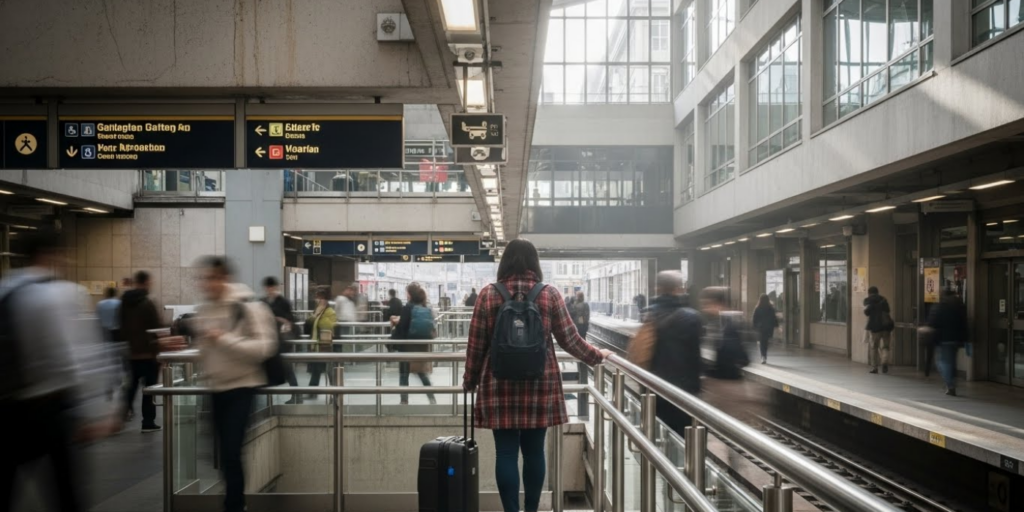
Transit systems use universal symbols and logic—you just need to know what to look for.
Maps:
- Lines are color-coded (e.g., red line, blue line).
- Circles or diamonds = stations.
- Intersections = transfer points.
- Arrows or terminal names (e.g., “Downtown” or “Airport”) = direction of travel.
Platform Signs:
- Digital displays show the next train’s destination and arrival time.
- Car numbers may indicate bike-friendly or quiet zones.
- Look for maps on the wall—they often match your app’s layout.
If you’re unsure:
- Follow the crowd during rush hour—locals know the way.
- Find a uniformed staff member or information desk. Most major systems have English-speaking help.
- Match your app to real life: Stand still, open Google Maps, and rotate your phone until the blue dot aligns with the station layout.
Golden Rule: Always check the final destination on the train or bus—not just the line color. Two trains on the same route might split to different suburbs!
Payment & Boarding: Avoiding Fines and Fumbles

Nothing ruins a smooth ride like getting fined for an invalid ticket. Here’s how to get it right:
Tap Correctly:
- On contactless systems, tap your card or phone on the reader until you hear a beep or see a green light.
- Don’t hover—hold it flat against the sensor for 1–2 seconds.
- If using a transit card, tap both when entering and exiting (in some cities like London or Vancouver).
Keep Proof of Payment:
In many European and Latin American cities, inspectors randomly check tickets on buses or trams. If you’re using a mobile ticket, keep it open on your screen. If you have a paper receipt, hold onto it until the end of your ride.
Don’t Block the Flow:
- Stand to the right on escalators (walk left) in most countries.
- Let passengers exit before you board.
- Move to the center of the car—don’t camp by the doors.
And if you accidentally get on the wrong train? Don’t panic. Most urban systems are loops or grids—you can usually reverse direction at the next station.
Cultural Etiquette: Blending In Without Saying a Word
Public transit runs on unspoken rules. Follow these, and you’ll look like you’ve lived there for years:
Universal Norms:
- Offer your seat to elderly, pregnant, or disabled riders.
- Keep bags on your lap in crowded spaces to avoid blocking aisles.
- Avoid loud phone calls or music—use headphones.
- Don’t eat strong-smelling food (especially on trains).
Regional Nuances:
- In Japan, silence is golden: no talking on phones, minimal conversation, and quiet footsteps.
- In Spain or Italy, buses won’t stop unless you signal—press a button or wave.
- In Germany, trains stop at every station by default—no need to signal.
- In many Asian cities, women-only cars operate during rush hour—respect the signage.
Safety & Awareness:
- Keep your phone and wallet in a front pocket or zipped bag.
- Avoid empty train cars late at night—stay where others are.
- If you feel unsafe, enter the nearest shop or hotel—staff can often call a ride or offer help.
Remember: Most locals appreciate when visitors make an effort. A smile, a quiet “thank you,” or a respectful nod goes a long way.
Troubleshooting Common Scenarios (Like a Local)
Even seasoned travelers hit snags. Here’s how to handle them calmly:
“I’m on the wrong train!”
→ Check the next stop on the digital display. Ride to the end of the line or the next transfer point—you can usually loop back easily.
“My card isn’t working!”
→ Look for a “Help” button at the gate or a station attendant. Many systems let you “top up” or reset cards on the spot.
“There’s a delay or strike!”
→ Apps like Citymapper will alert you. Have a backup route (e.g., a bus instead of the subway). In many cities, transit apps suggest alternatives automatically.
“I don’t speak the language!”
→ Use Google Translate’s camera mode to read signs in real time.
→ Show your destination on your phone map to a driver or fellow passenger.
“I have luggage!”
→ Avoid rush hour. Use elevators (not escalators) where available.
- In cities like Prague or Budapest, some stations lack elevators—check accessibility maps in advance on Google Maps (look for the wheelchair icon).
Final Thoughts: Move With the City, Not Through It
Using public transit like a local isn’t about perfection—it’s about presence. It’s about trading the isolation of a backseat for the shared energy of a community in motion. Every swipe, every turn, every shared glance is a quiet act of belonging.
And with the tools in this guide—smart prep, real-time apps, cultural awareness, and a calm mindset—you’re ready to navigate any urban landscape with ease.
So next time you land somewhere new, skip the taxi queue. Walk to the nearest station, tap your card, and let the city carry you forward. The best journeys aren’t just about where you go—they’re about how you move through the world.
What’s your best (or funniest) public transit story? Did you ever get lost—and find something amazing instead? Share your experience in the comments below! Your tip might help another traveler turn confusion into adventure.

Michael Thompson is an enthusiast of travel, restaurants, financial freedom, and personal performance. He enjoys discovering new destinations and exploring local cuisine while constantly working on self-improvement and independence. For Michael, life is about creating meaningful experiences, growing every day, and building a lifestyle that combines freedom, discipline, and curiosity.