
Introduction
You step off the subway in Tokyo, turn a few corners, and suddenly—everything looks the same. The towering buildings, the crowds, the neon signs… you’re completely disoriented. Your phone battery is at 12%, and your hotel is “just five minutes away”—or so you thought. Sound familiar? In sprawling metropolises like New York, London, or Bangkok, even the most confident travelers can find themselves spinning in circles.
But here’s the good news: getting lost isn’t inevitable. With the right strategies, tools, and mindset, you can move through any big city with confidence, efficiency, and even a sense of adventure. Navigating urban landscapes isn’t about memorizing every street—it’s about understanding patterns, using smart resources, and staying calm when things shift.
In this guide, we’ll share the best, most practical ways to navigate big cities without getting lost. You’ll learn how to use maps like a local, recognize urban layouts, leverage technology wisely, and even find your way when your phone dies. Whether you’re a first-time visitor or a frequent traveler, these tips will help you explore with freedom—not fear. So take a deep breath, look up from your screen, and let’s turn confusion into confidence.
1. Understand the City’s Layout Before You Arrive
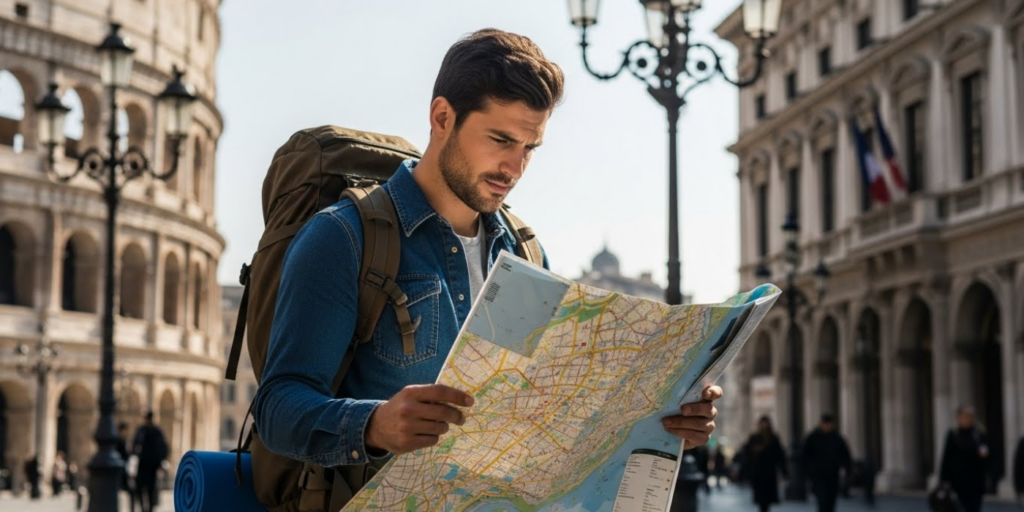
Not all cities are built the same—and knowing the basic structure of your destination is your first line of defense against disorientation.
Grid cities (like Chicago, Barcelona, or Manhattan) are the easiest to navigate. Streets run in predictable north-south and east-west lines, often numbered or alphabetically labeled. In Manhattan, for example, streets increase numerically as you go north—so “50th Street” is always below “70th Street.”
Organic cities (like Rome, Boston, or Prague) grew naturally over centuries, with winding alleys, odd angles, and circular plazas. In these places, landmarks are your best friends. Instead of memorizing street names, note key reference points: “My hotel is two blocks east of the cathedral,” or “The museum is across from the red bridge.”
Zoned cities (like Dubai, Los Angeles, or Seoul) group districts by function—downtown for business, suburbs for housing, cultural quarters for museums. Knowing this helps you avoid crisscrossing the city unnecessarily.
Pro tip: Before your trip, spend 10 minutes studying a simple map of the area. Identify major streets, rivers, parks, and transit lines. These act as “anchors” for your mental geography. Google Maps’ satellite view is especially helpful—you can spot the shape of a river or the curve of a coastline that orients you instantly.
2. Use Digital Maps Smartly (And Know Their Limits)
Yes, your phone is a navigation superpower—but it’s not foolproof. Relying solely on turn-by-turn directions can leave you helpless when your battery dies, the signal drops, or the app glitches.
Best practices for digital navigation:
- Download offline maps before you go. Google Maps, Maps.me, and Citymapper all let you save entire cities for offline use—including transit routes and walking directions.
- Enable “compass mode” so your blue dot rotates with your direction, not just the map orientation. This helps you align your screen with the real world.
- Use “transit-friendly” routing in Google Maps—it prioritizes walking to the nearest station over driving, which is crucial in car-heavy cities.
But don’t stare at your screen. Glance, then look up. Match what you see on the map with real-world cues: “Okay, the map says I should see a tall clock tower ahead—there it is!”
Critical backup: Always carry a small paper map or save a screenshot of your route. In subway tunnels or dense urban canyons, GPS often fails. A static image won’t.
Also, charge your phone—or carry a portable power bank. Nothing induces panic faster than a dead phone in an unfamiliar alley.
3. Master Public Transit Like a Local
In most big cities, public transportation is the fastest, cheapest, and most efficient way to get around. And once you understand the system, you’ll feel like a true urban insider.
Start by downloading the official transit app for your destination:
- Citymapper (works in 100+ cities worldwide)
- Moovit (real-time updates and crowd-sourced alerts)
- Local apps like MYmta (New York), TfL Go (London), or Japan Transit Planner (Tokyo)
Key habits of confident transit users:
- Get a reloadable transit card (like London’s Oyster, Paris’s Navigo, or Hong Kong’s Octopus). They’re faster than buying tickets and often cap daily fares.
- Learn the main lines and hubs. You don’t need to memorize every stop—just know the backbone routes that connect major areas.
- Stand on the right on escalators in cities like London, Tokyo, or Singapore (left side is for walking).
- Avoid rush hour (7–9 a.m. and 5–7 p.m.) if possible—trains are packed, delays are common, and stress levels soar.
Bonus: Transit maps are often color-coded and simplified. Study them like a subway “skeleton”—once you know Line A connects the airport to downtown, you’ve cracked the code.
4. Walk with Purpose—and Pay Attention

Walking is often the best way to explore dense urban cores—but it requires awareness.
Walk like you belong:
- Keep your head up (not buried in your phone)
- Move with steady confidence—even if you’re unsure
- Step aside to check maps or take photos (don’t block sidewalks)
Use “breadcrumbing”: As you walk, mentally note distinctive landmarks—a mural, a bakery with blue awnings, a park entrance. If you turn around, these become your trail back.
Follow the flow: In cities like Tokyo or Paris, locals tend to walk on the left or right consistently. Matching their rhythm keeps you from bumping into people and helps you move smoothly.
Night navigation tip: Stick to well-lit, populated streets. If you’re unsure, pop into a café or convenience store to reorient—staff are often happy to point you in the right direction.
Remember: getting slightly off track can lead to your best discoveries—a hidden courtyard, a street musician, a tiny bookstore. The goal isn’t perfection—it’s presence.
5. Learn Basic Orientation Cues (No Compass Needed)
You don’t need a compass to find north. Use natural and urban cues instead:
- Sun position: In the Northern Hemisphere, the sun rises in the east and sets in the west. At noon, it’s roughly south.
- Building shadows: In the morning, shadows point west; in the evening, they point east.
- Transit direction signs: Subway platforms often label directions as “Uptown/Downtown” (NYC) or “Northbound/Southbound.” Learn what those mean in your area.
- Water bodies: Many cities are built along rivers or coasts. Knowing “the river is to the east” instantly orients you.
Pro insight: In Tokyo, streets rarely have names—but buildings have numbers that follow a geographic order, not sequential logic. Locals navigate by district + block + building number. In such cases, addresses are useless without a map—so rely on apps and landmarks instead.
6. Ask for Help—The Right Way
Asking for directions isn’t a sign of weakness—it’s a smart traveler’s secret weapon. But who you ask matters.
Best people to approach:
- Store clerks (they’re stationary and know the neighborhood)
- Police officers or transit staff (uniformed = reliable)
- Families or older couples (often more trustworthy than random strangers)
Avoid: People who seem rushed, overly eager, or hover near tourist spots (some may be scammers).
Phrase it clearly:
“Excuse me, I’m looking for [landmark]. Is it within walking distance?”
“Could you point me to the nearest subway station?”
In non-English-speaking countries, learn one phrase:
“Where is…?” + point to your map or phone image.
Bonus: Carry a hotel business card. Hand it to a taxi driver or ask a local to point you back—no language needed.
7. Build a “Home Base” Mental Map
When you arrive, create a “home base” map in your mind. Walk a 10-minute radius from your hotel or Airbnb and note:
- Nearest subway/bus stop
- A convenience store or pharmacy
- A recognizable landmark (statue, church, tall building)
- A café or restaurant you like
This “safe zone” becomes your anchor. Even if you wander far, you can always return here to reset.
Pro tip: Take a photo of your building’s entrance—it might look different when you return at night.
Conclusion
Navigating a big city without getting lost isn’t about having a perfect sense of direction—it’s about preparation, observation, and adaptability. By understanding a city’s layout, using technology wisely, mastering transit, and staying present, you transform urban exploration from a source of stress into a joyous act of discovery.
Remember: even locals get turned around sometimes. What matters isn’t avoiding mistakes—it’s how you respond to them. With these strategies, you’ll move through any metropolis with calm, curiosity, and confidence.
So next time you’re in a new city, take a deep breath, look up, and trust yourself. The streets are waiting to be explored—not feared.
Have you ever gotten lost in a big city and stumbled upon something amazing? What’s your go-to navigation hack? Share your story in the comments—we’re all learning from each other! And if this guide helped you feel more empowered, pass it along to a fellow traveler who’s ready to conquer their next urban adventure. Happy (and confident) exploring!

Michael Thompson is an enthusiast of travel, restaurants, financial freedom, and personal performance. He enjoys discovering new destinations and exploring local cuisine while constantly working on self-improvement and independence. For Michael, life is about creating meaningful experiences, growing every day, and building a lifestyle that combines freedom, discipline, and curiosity.