Introduction
You’ve seen it happen: you return from an incredible trip, scroll through hundreds of nearly identical photos—“you at the Eiffel Tower,” “you at the Colosseum,” “you with a plate of pasta”—and realize something’s missing. The feeling of the place, the sounds, the little moments that made you laugh or pause in awe… they’re not quite there.
Photos are powerful, but they’re only one piece of the memory puzzle. The most meaningful travel memories live in the details: the smell of rain in a Kyoto temple garden, the taste of street food shared with a stranger, the way the light hit a cobblestone street at dusk.
So how do you capture those intangible moments?
In this guide, we’ll explore creative, joyful, and deeply personal ways to preserve your travel memories—beyond just snapping pictures. From analog journals and audio snippets to curated keepsakes and collaborative storytelling, these ideas will help you build a rich, multi-sensory record of your journey that you’ll treasure for years.
Get ready to slow down, pay attention, and fall in love with remembering.
1. Keep a Travel Journal—But Make It Your Own
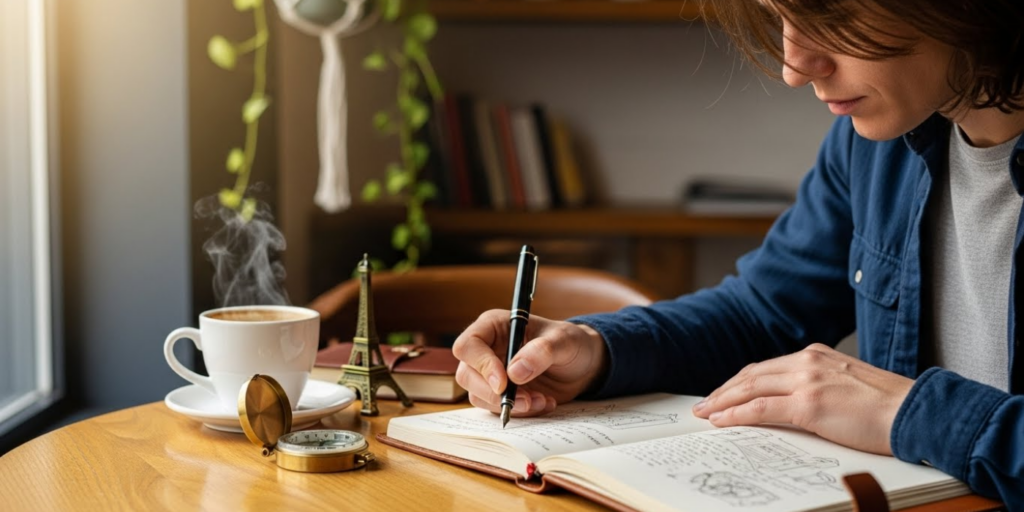
A journal isn’t just a log of where you went—it’s a living archive of how you felt. And you don’t need to be a writer to make it work.
Start simple: each evening, jot down three things:
- One thing you saw that surprised you
- One thing you tasted that delighted you
- One small moment that made you smile
But go further. Use mixed media to bring your journal to life:
- Press a flower from a hike in the Alps
- Tape in a metro ticket or café receipt
- Sketch a quick doodle of your breakfast spread
- Write a haiku about the ocean in Bali
Pro tip: Leave space for “future you.” Write letters like, “Dear me in 10 years—remember how nervous you were ordering coffee in Portuguese? Look at you now!”
Many travelers find that writing by hand creates a deeper connection to the moment than typing. The slowness forces you to reflect, not just record.
Think of your journal as a time capsule—not for the world, but for your future self. Years later, it’s not the perfect grammar that will move you—it’s the smudged ink from rain in Lisbon or the coffee stain from that tiny café in Rome.
2. Capture Sound and Voice—The Forgotten Senses
We’re so visual that we forget: travel sounds are powerful memory triggers. The call to prayer in Istanbul, street musicians in Barcelona, waves on a Thai beach, the clink of espresso cups in Naples—these sounds transport you back instantly.
Use your phone’s voice memo app (or a simple recording app like Voice Recorder) to capture:
- A local market’s morning bustle
- A friend’s laughter during a shared meal
- Your own thoughts after a big museum visit (“Wow, that Van Gogh exhibit left me speechless…”)
Bonus: Record short “audio postcards.” Say, “Hi future me—it’s 7 a.m. in Hanoi, and I’m drinking egg coffee while motorbikes zoom past like a symphony of chaos.”
Later, you can compile these into a private podcast or add them to a digital scrapbook.
Unlike photos, audio recordings capture emotion in real time—your tired joy, your wonder, your quiet awe. And years later, hearing your own voice from a past adventure is nothing short of magical.
3. Curate Meaningful Keepsakes (Not Just Souvenirs)
Skip the mass-produced keychains and fridge magnets. Instead, collect small, authentic items that tell a story:
- A smooth stone from a riverbank in Slovenia
- A handwritten recipe from a cooking class in Mexico
- A fabric scrap from a textile market in Morocco
- A pressed leaf from a Kyoto garden
Store them in a memory box or shadow box at home. Label each with a tiny note: “Found this on my solo hike—felt like the world was mine alone.”
Pro idea: Create a “scent memory.” Buy a local soap, spice, or essential oil (like lavender from Provence or sandalwood from India). Smell is the most powerful memory sense—years later, a whiff can instantly return you to that place.
These objects aren’t decor—they’re tactile anchors for your experiences. They invite touch, curiosity, and conversation far more than a generic snow globe ever could.
4. Use Photography with Intention—Not Just Volume
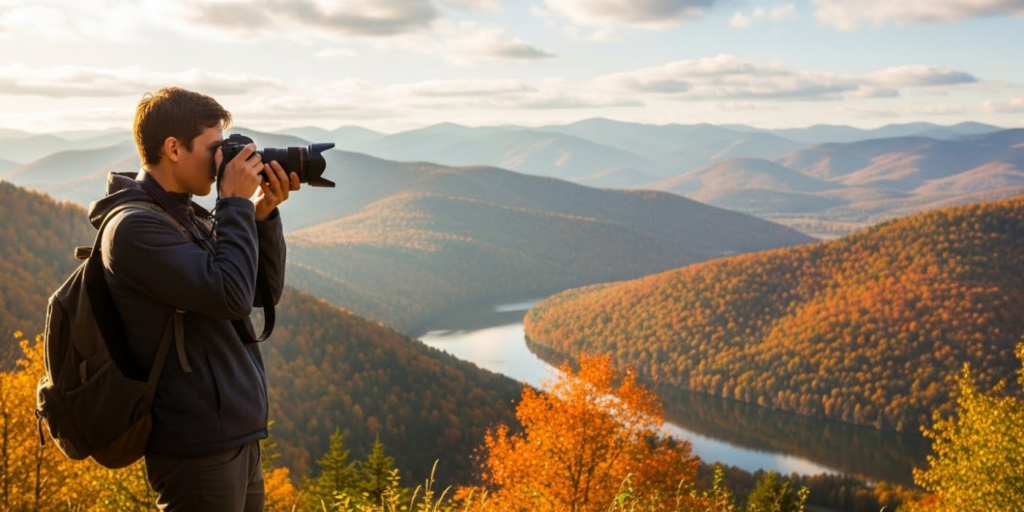
Yes, take photos—but shoot like a storyteller, not a tourist. Instead of another statue selfie, ask: What does this place feel like?
Try these creative prompts:
- Capture details: Wrinkled hands of a street vendor, steam rising from a bowl, rain on a windowpane
- Shoot from new angles: Crouch low, climb high, frame through archways or foliage
- Document daily rituals: Your morning coffee, your shoes by the door, the view from your hostel bunk
- Create a photo series: “Doors of Lisbon,” “Shadows in Marrakech,” “Blue things in Santorini”
Pro tip: Use your phone’s portrait mode or grid lines to improve composition. And delete duplicates ruthlessly—quality over quantity.
Most importantly: put the camera down sometimes. Some moments are meant to be lived, not framed. You’ll remember them better that way.
Remember: a single powerful photo of a wrinkled map on a café table can say more about your journey than 50 posed shots.
5. Build a Collaborative Memory Project
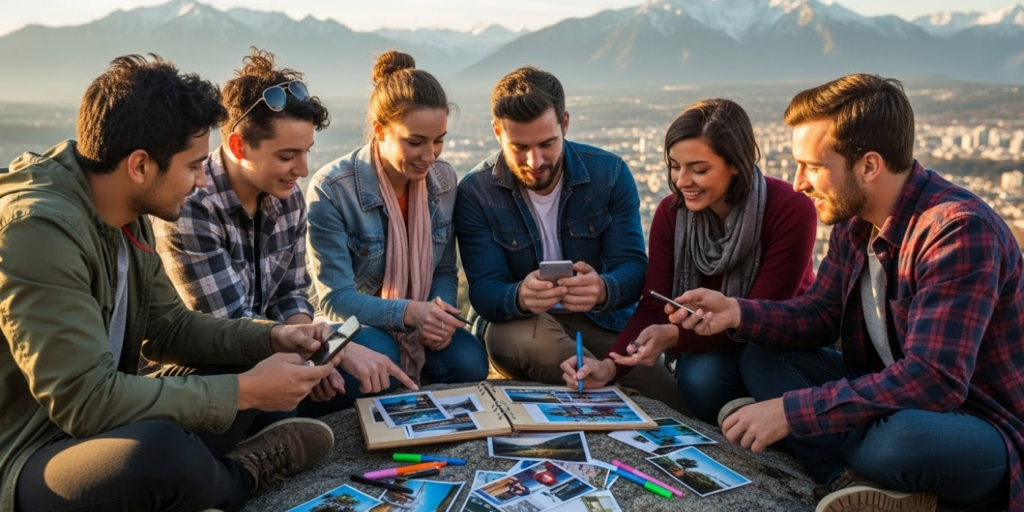
Travel memories multiply when shared. Involve your travel companions (or even people back home) in creative documentation:
- Start a shared digital album (Google Photos, Dropbox) where everyone uploads their favorite shots—and captions them with stories.
- Trade postcards: Mail real postcards to each other from the road with handwritten notes.
- Create a group map: Use Google My Maps to pin favorite spots with photos and personal reviews.
- Record a “trip highlight reel” together on the last night—each person shares their top moment, filmed on a phone.
If you’re traveling solo, connect with locals or fellow travelers. Ask to take their photo (with permission), or exchange small stories. Sometimes, the briefest human connection becomes the most vivid memory.
These collaborative efforts turn your trip into a shared narrative—one that grows richer with every retelling.
Bonus Tips: Simple Tools to Spark Creativity
- Use a polaroid or disposable camera for a fun, low-pressure analog break from digital perfection.
- Try a “one-second video” app (like 1 Second Everyday) to compile tiny clips into a year-in-review-style montage.
- Buy a local notebook in each destination—the paper texture, cover design, and even smell become part of the memory.
- Write postcards to your future self and mail them home using services like FutureMe.org.
The goal isn’t to document everything—it’s to notice more deeply.
Conclusion
The best travel memories aren’t the ones with the most likes—they’re the ones that live in your bones. By engaging your senses, slowing down, and choosing creative over convenient, you’ll build a personal archive that’s rich, emotional, and utterly unique.
You don’t need expensive gear or artistic talent. You just need curiosity, presence, and a willingness to capture what moves you—not what’s Instagrammable.
So next time you travel, leave room in your bag for a notebook, your ears open for beautiful sounds, and your heart ready to notice the small magic. Because years from now, you won’t remember how many photos you took—you’ll remember how alive you felt.
What’s your favorite way to preserve travel memories? Do you journal, collect objects, or have a unique ritual? Share your method in the comments below! And if this inspired you, pass it on to a fellow traveler who believes memories are meant to be cherished—not just stored in a cloud. 🌍✨📓

Michael Thompson is an enthusiast of travel, restaurants, financial freedom, and personal performance. He enjoys discovering new destinations and exploring local cuisine while constantly working on self-improvement and independence. For Michael, life is about creating meaningful experiences, growing every day, and building a lifestyle that combines freedom, discipline, and curiosity.